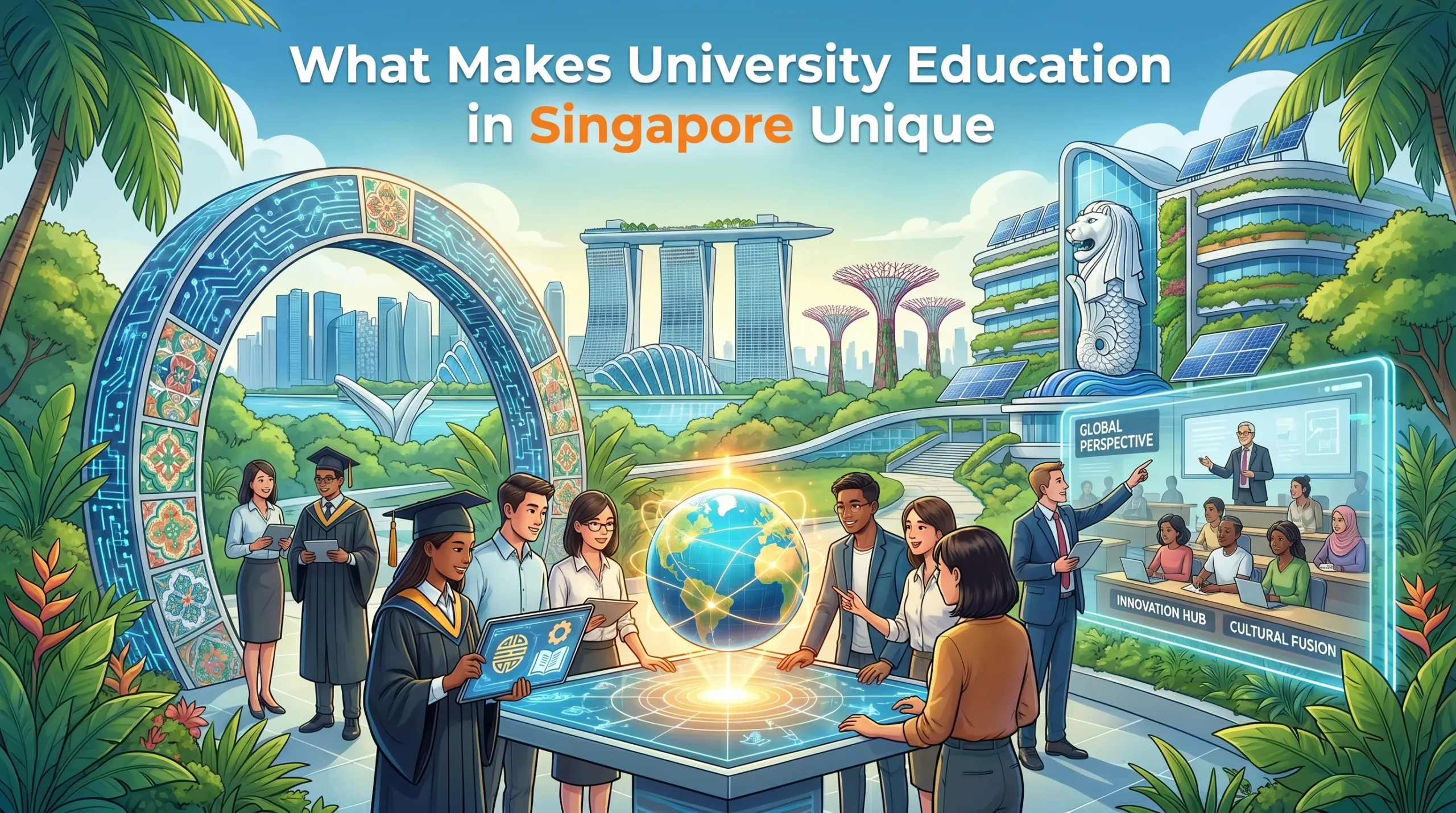
You experience something special with university education in singapore. Top universities like NUS and NTU consistently rank among the world’s best:
|
University |
Global Rank |
Asia Rank |
|---|---|---|
|
NUS |
8 |
1 |
|
NTU |
12 |
3 |
You join a vibrant, multicultural campus that blends Eastern and Western cultures, unlike the more Western-focused environments in Melbourne or London. You see how education in singapore opens doors to respected careers. Next, you will discover what drives this level of academic excellence.
Key Takeaways
-
Singapore’s top universities, NUS and NTU, rank among the best globally, offering world-class education and resources.
-
A multicultural campus environment enriches your learning experience, allowing you to appreciate diverse cultures and perspectives.
-
Interdisciplinary programs enable you to combine fields of study, preparing you for a flexible and innovative workforce.
-
High graduate employability rates reflect the strong connection between education and job opportunities in Singapore.
-
Access to scholarships and financial aid helps manage tuition costs, making education in Singapore more accessible.
Academic Excellence
World Rankings
You see Singapore’s universities stand out in the world of higher education. The National University of Singapore (NUS) and Nanyang Technological University (NTU) lead not only in Asia but also on the global stage. According to the QS World University Rankings, Singapore’s higher education system has shown the most improvement worldwide.
NUS alone has 28 subjects ranked in the global top 10, which shows the strength of its academic programs.
Singapore’s universities receive recognition from international organizations for their top-tier programs and consistent performance.
Here is how Singapore’s top universities compare with others in the region:
|
University Name |
Global Ranking |
Region |
|---|---|---|
|
National University of Singapore |
Leading |
ASEAN |
|
Nanyang Technological University Singapore |
Leading |
ASEAN |
|
Sunway University |
301-350 |
Malaysia |
You join a higher education system that offers you access to world-class resources and opportunities. Singapore’s universities have 42 subjects ranked in the top 10 globally, which is rare for a small country.
Faculty & Research
You benefit from faculty who lead in research and innovation. Nearly 40 researchers from NUS appear on the Highly Cited Researchers 2025 list. These experts make important contributions in Chemistry, Business, Engineering, and Materials Science. NTU also ranks 5th globally in interdisciplinary science, which shows its commitment to impactful research.
-
NUS and NTU faculty drive progress in sustainable and innovative academic practices.
-
You learn from professors who shape the future of higher education through their discoveries.
You gain more than just knowledge in Singapore. You become part of a higher education community that values research, creativity, and global impact.
Innovative Curriculum
Interdisciplinary Programs
You find that Singaporean universities encourage you to cross traditional academic boundaries. You can combine different fields to create a unique learning path. This approach prepares you for the modern workforce, where employers value flexible thinkers.
Many universities in Singapore offer dual degrees and interdisciplinary courses. For example, you might pair business with engineering or data science. Some programs even let you study in more than one country.
Here are some popular combinations:
|
Field of Study |
Popular Dual Pairing |
Destination Example |
|---|---|---|
|
Business & Finance |
MBA or Master’s in Finance with Engineering or Data Science |
ESSEC (France) & NUS (Singapore) |
|
International Relations |
Political Science/Global Affairs with Public Policy or Journalism |
Sciences Po (France) & Columbia University (USA) |
|
Engineering & Tech |
Master of Technology with an overseas Research Degree |
IIT Bombay (India) & Monash University (Australia) |
You see how these options give you a global perspective. Many students choose international programs to experience different cultures and academic styles. This exposure helps you adapt to new environments and prepares you for global careers.
Research Opportunities
You get the chance to participate in research early in your studies. Singaporean universities invest heavily in research facilities and projects. You might join a lab, work on real-world problems, or even publish your findings before graduation.
-
You can collaborate with professors on cutting-edge topics.
-
You may join research teams that partner with industry leaders.
These experiences help you build practical skills and a strong resume. You learn how to ask questions, test ideas, and communicate your results. By the time you graduate, you have more than just classroom knowledge—you have hands-on experience that sets you apart.
Campus Life & Diversity
Multicultural Community
You join a campus where diversity shapes your daily experience. Singapore’s universities welcome students from all over the world. Foreign students make up about 10% of the undergraduate intake in the seven public universities. You meet classmates from Asia, Europe, Africa, and the Americas. This mix of backgrounds creates a unique environment where you learn to appreciate different cultures and viewpoints.
You hear many languages on campus, including English, Mandarin, Malay, and Tamil. You celebrate holidays from different countries with your friends. You share meals, stories, and traditions. This exposure helps you develop global awareness and respect for others.
Student Activities
You find many ways to get involved outside the classroom. Singaporean universities offer more than 100 student clubs and organizations. You can join sports teams, music groups, debate societies, or cultural clubs. These activities help you discover new interests and make friends from different backgrounds.
-
Induction Week welcomes you with events like dragon boat racing and scavenger hunts. You bond with new students and learn about local customs.
-
The annual Global Village event lets you share your culture through food and performances. You see how students from many countries express their heritage.
-
Community engagement projects, such as ESSEC Volunteering Day, give you the chance to help others and connect with the local community.
-
Support systems and inclusive policies ensure you feel safe and respected. You can express yourself and join open discussions on campus.
You build leadership skills, confidence, and lifelong friendships through these experiences. Campus life in Singapore helps you grow as a person and prepares you for a global future.
Why University Education in Singapore Stands Out
Six Autonomous Universities
You benefit from a higher education system built on six autonomous universities, each with a unique academic focus. These universities give you a wide range of choices, so you can find a program that matches your interests and career goals. Here is what sets each one apart:
-
National University of Singapore (NUS): You access a broad selection of undergraduate and postgraduate programs. NUS stands out as a leading research university, known for its global reputation and academic excellence.
-
Nanyang Technological University (NTU): You find a similar range of degree programs at NTU. This university also leads in research and innovation, especially in science and engineering.
-
Singapore Management University (SMU): You focus on business management, law, and social sciences. SMU offers a city campus experience and encourages interactive learning.
-
Singapore University of Technology and Design (SUTD): You explore design and technology in a hands-on environment. SUTD prepares you for careers in engineering, architecture, and innovation.
-
Singapore Institute of Technology (SIT): You follow applied learning pathways, especially if you come from a polytechnic background. SIT connects you with industry partners and real-world projects.
-
Singapore University of Social Sciences (SUSS): You specialize in social sciences and professional education. SUSS supports working adults and lifelong learners.
You see how these universities offer a variety of academic, research, and work-learn programs. This diversity helps you find the right fit, whether you want to pursue research, develop practical skills, or prepare for a specific profession. The structure of university education in Singapore ensures that you receive both depth and breadth in your studies.
Pathways to Good Jobs
You discover that education in Singapore is more than just earning a degree. Employers respect university education in Singapore because it prepares you for the workforce. You gain practical experience through internships, industry projects, and work-study programs. These opportunities help you build a strong resume before you graduate.
You can see the results in the high employment rates for graduates. Most students secure jobs quickly after finishing their studies. Here is a look at the latest employment statistics:
|
Employment Status |
Percentage |
|---|---|
|
Graduates looking for work employed |
|
|
Overall fresh graduate employment rate |
87.1% |
You join a system where university education leads to real opportunities. Employers value your skills and training. You find that many graduates receive job offers even before graduation. This strong link between education and employment makes university education in Singapore a respected and effective route to a successful career.
Higher Education in Singapore: Industry Connections
Internships & Work-Study
You experience strong industry connections when you pursue higher education in singapore. Universities partner with global companies to create opportunities for internships and work-study programs. You gain real-world experience and build your professional network before graduation.
For example, NUS collaborates with Google to offer applied AI research, talent development programs, and Google-supported professorships.
|
University |
Industry Partner |
Focus Area |
Initiatives |
|---|---|---|---|
|
NUS |
|
Applied AI |
Joint research center, talent development program, Google-supported professorship |
You join programs that connect you with industry mentors and hands-on projects. Many students participate in internships during their studies. You learn how to solve real problems and develop skills that employers value. Higher education in singapore gives you access to these opportunities, making your learning practical and relevant.
Graduate Employability
You see the impact of higher education when you look at graduate employability. Singaporean universities report high employment rates and strong starting salaries. You benefit from a system that prepares you for success in the job market. The median gross monthly salary for fresh graduates is S$4,500. Salaries in digital careers range from S$3,500 to S$10,000, depending on your skills and industry demand.
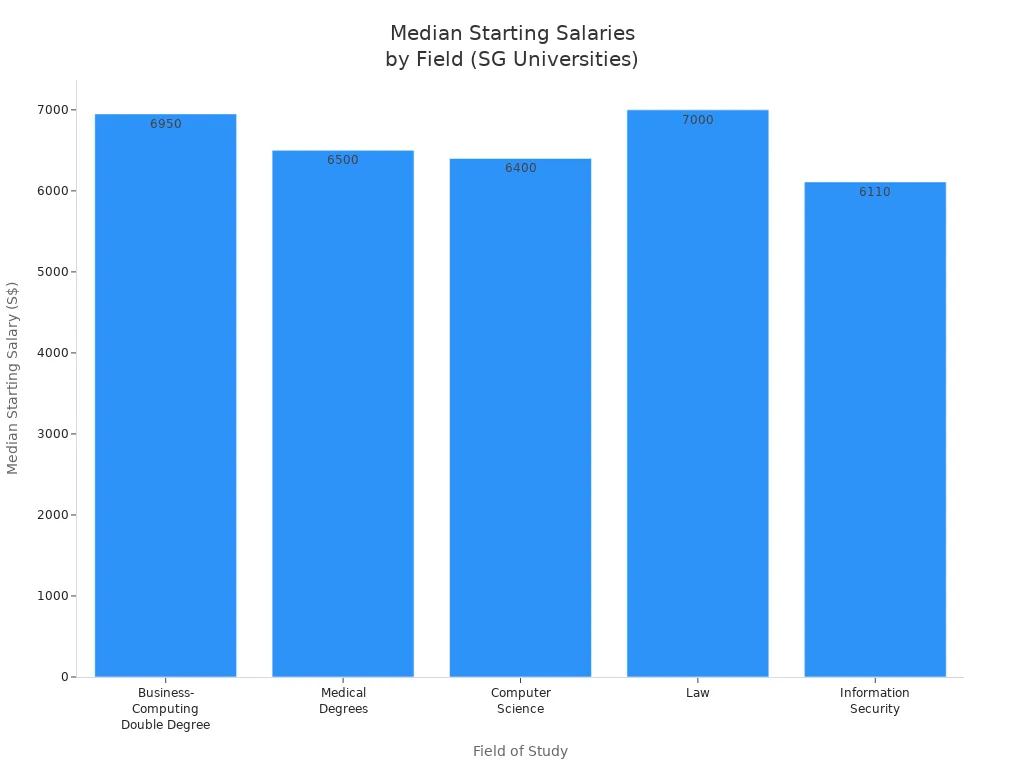
You can see how different fields offer competitive salaries:
|
Field of Study |
Median Starting Salary (S$) |
|---|---|
|
Business-Computing Double Degree (NTU) |
6,950 |
|
Medical Degrees (NTU, NUS) |
6,500 |
|
Computer Science (NUS) |
6,400 |
|
Law (NUS, SMU) |
7,000 |
|
Information Security (NUS) |
6,110 |
|
Overall Median Salary for Fresh Graduates |
4,500 |
|
Other Computing-Related Programs (SIT, NUS, SMU) |
5,000 – 6,400 |
You join a higher education system that connects you with employers and helps you start your career strong. You see how higher education in singapore leads to good jobs and financial stability.
Admissions & Funding
Application Process
You face a competitive admissions process when you apply to Singaporean universities. The acceptance rate for international students at the National University of Singapore (NUS) usually falls between 5% and 10%. For undergraduate programs, the rate often ranges from 7% to 9%. This selectivity means you need to prepare a strong application.
International students make up about 39% of the student body, so you join a diverse and ambitious community.
You must meet specific academic requirements based on your qualifications. The table below shows common criteria for different education systems:
|
Qualification Type |
Criteria |
|---|---|
|
A-level |
Specific grades required for various courses, e.g., NUS Computer Science requires AAA plus A in Mathematics. |
|
IB |
Minimum scores for courses, e.g., NUS Medicine requires 42+ with specific subject grades. |
|
SAT/US qualifications |
Minimum SAT scores and AP requirements for courses, e.g., NUS Computer Science requires SAT 1500+. |
|
Indian Std 12 |
Minimum aggregate of 85-90% in best-of-four subjects. |
|
Chinese Gaokao |
Scores above the Tier 1 cut-off in the province. |
|
Language Requirements |
Minimum IELTS score of 6.5, TOEFL iBT of 85-90, with higher scores for competitive programs. |
You should check the requirements for your chosen course and prepare all necessary documents. Most universities ask for academic transcripts, standardized test scores, and proof of English proficiency.
Scholarships & Financial Aid
You have access to a range of scholarships and financial aid options in Singapore. These opportunities help you manage tuition and living expenses:
-
Government-funded scholarships, such as the Singapore International Graduate Award (SINGA) and the Ministry of Education (MOE) Tuition Grant, support many international students.
-
University-specific scholarships include the Nanyang Scholarship at NTU and the President’s Graduate Fellowship at NUS.
-
Private organizations offer awards like the ASEAN Undergraduate Scholarship and the Lee Kuan Yew Scholarship.
-
Merit-based scholarships, such as the Global Citizen Scholarship, recognize students with outstanding achievements.
You find that Singapore’s universities invest in attracting talented students from around the world. With careful planning, you can secure funding and focus on your studies.
Student Support & Housing
Accommodation Options
You have several choices when it comes to finding a place to live while studying in Singapore. Most universities offer a range of accommodation types to suit your needs and preferences. Here are the most common options:
-
University-managed halls: These are popular with first-year students. You get essential facilities and a supportive community.
-
Private student hostels: Third-party providers manage these hostels. You enjoy fully furnished rooms and extra services.
-
Shared apartments: Many postgraduates choose this option. You share an apartment with other students and gain more independence.
-
Homestay: You live with a local family. This helps you experience Singaporean culture up close.
You should also consider the cost of each option. The table below compares average monthly rents for different types of student housing in Singapore:
|
Accommodation Type |
Average Monthly Rent (SGD) |
Details / Notes |
|---|---|---|
|
University Halls/On-campus Dorms |
325 – 1,000 |
Affordable, shared rooms; usually 4–6 students per room; utilities often included. |
|
Private Student Hostels |
600 – 1,500 |
More amenities than campus halls; utilities may be included or minimal. |
|
Shared Apartments (HDB/Private) |
700 – 2,000 (per room) |
HDB flats: 700–1,200 per room; entire flat: varies. |
Student Services
You receive strong support from your university to help you succeed both academically and personally. Singaporean universities provide a wide range of services designed to enhance your well-being:
-
The Singapore Institute of Management (SIM) offers academic support to help you adjust after National Service.
-
The SIM Student Learning Centre runs workshops on academic writing and study skills.
-
The Peer-Assisted Learning (PAL) Programme lets high-performing students lead group study sessions.
-
The Student Wellness Centre and Student Care services provide counseling and stress management programs.
-
SIM encourages you to join student communities and peer networks, which help you build friendships and resilience.
You find that these services create a supportive environment. You can focus on your studies, make new friends, and take care of your mental health. Singaporean universities want you to thrive both inside and outside the classroom.
You gain access to world-class academics, strong industry connections, and a vibrant multicultural campus when you choose university education in singapore. Education in singapore offers you support through orientation, academic resources, and career services. International students and parents benefit from high graduate employability and diverse career paths. If you want to apply, start by researching universities, preparing documents, and exploring scholarships. You can find housing options and support offices to help you adapt.
|
Description |
|
|---|---|
|
Orientation and Campus Life |
Campus tours, information sessions, and social activities help you settle in. |
|
Academic Support |
Library resources, writing centers, and peer tutoring guide your studies. |
|
Career Services |
Internships, resume help, and networking events prepare you for jobs. |
|
Mental Health and Wellbeing |
Counseling and wellness workshops support your well-being. |
|
International Student Office |
Visa help, housing guidance, and cultural adaptation assistance. |
-
Application Process: Submit documents like passport, photos, offer letter, and proof of financial resources.
-
Scholarships: Look for awards such as ASEAN Undergraduate Scholarship and Nanyang Scholarship.
-
Accommodation Options: Choose between on-campus housing or private rentals.
FAQ
What language do universities in Singapore use for teaching?
English is the main language of instruction. You will attend lectures, submit assignments, and take exams in English. Most universities require proof of English proficiency for admission.
Can you work while studying at a Singapore university?
Yes, you can work part-time up to 16 hours per week during term time if you hold a Student Pass. You can also work full-time during vacation periods.
How do you apply for student accommodation?
You apply for university-managed housing through the university’s online portal. You should apply early because spaces fill up quickly. Private hostels and shared apartments are also available.
What support do international students receive?
You get help from international student offices, orientation programs, and peer mentors. Universities offer counseling, academic support, and visa guidance to help you adjust and succeed.