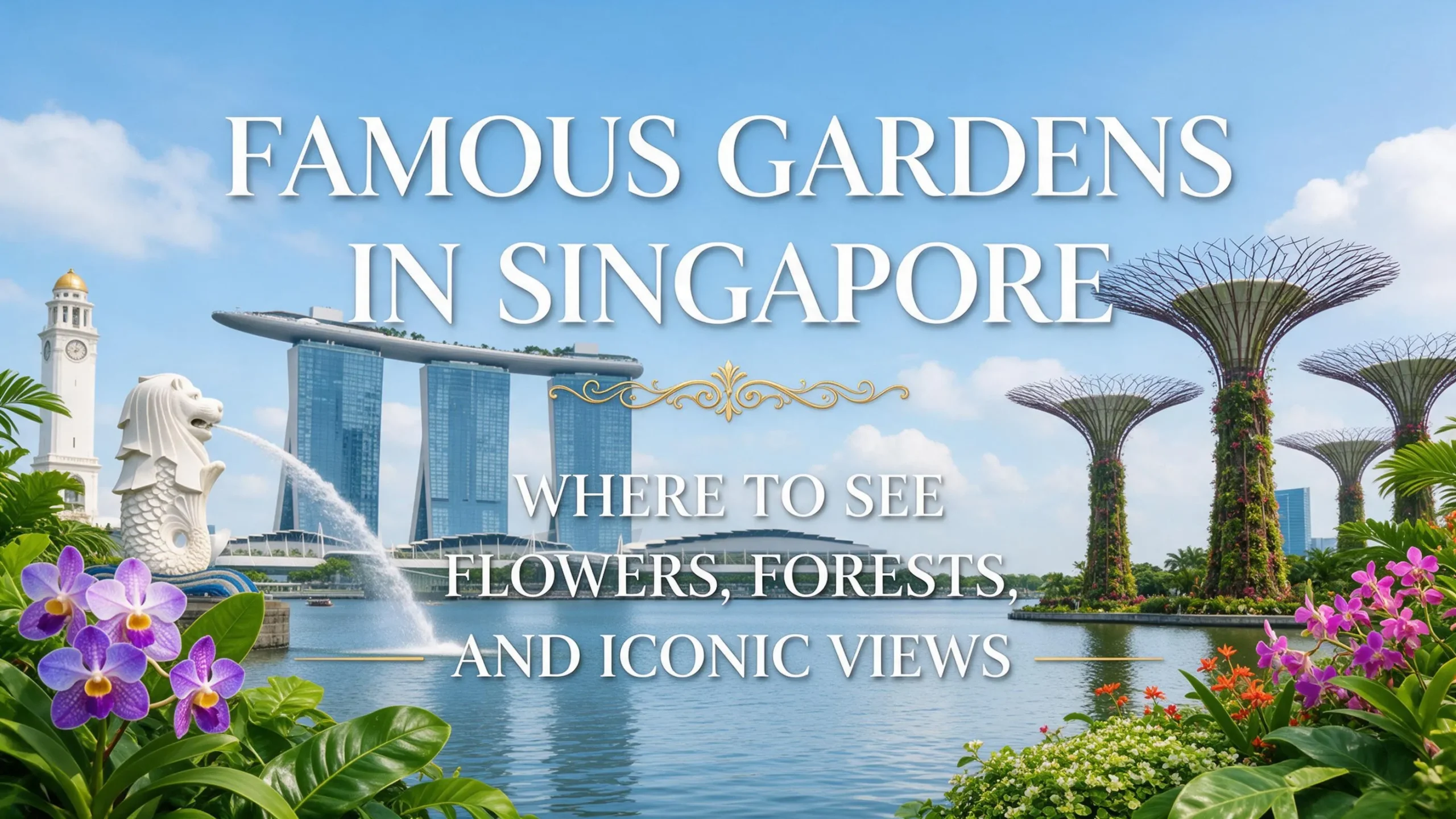
Singapore’s famous gardens range from free tropical landscapes and historic parks to ticketed conservatories and a UNESCO World Heritage site. Gardens by the Bay is a standout for first-time visitors, with its Supertrees, climate-controlled conservatories, and skyline views, while Singapore Botanic Gardens and the National Orchid Garden offer an exceptional botanical collection, including more than 1,000 orchid species and 2,000 hybrids.
For a quieter visit, explore Fort Canning Park’s history, the Chinese and Japanese Gardens’ East Asian-inspired landscapes, or HortPark’s practical gardening displays. The comparison table below summarizes each garden’s location, entry arrangements, and standout features.
Why Singapore Feels Like a City Inside a Garden
Singapore’s density makes its green spaces unusual. A short MRT ride from Orchard Road or Marina Bay can put you under rainforest canopy, inside a cooled orchid house, or on a historic hill above the civic district. The city’s most famous gardens are not simply lawns with flowerbeds. They operate as conservation sites, outdoor classrooms, venues for light shows, and deliberate parts of national planning.
That investment has produced globally recognized landscapes. Singapore Botanic Gardens was inscribed as a UNESCO World Heritage Site in 2015, becoming Singapore’s first site on the list and the first tropical botanic garden on the UNESCO World Heritage List. Gardens by the Bay has reshaped what visitors expect from a park, combining engineering with horticulture. The result is a city where green space is treated as public infrastructure.
Gardens by the Bay: Supertrees and Two Different Climates
Gardens by the Bay is the most visually recognizable garden in Singapore. The Supertree Grove is free to enter and consists of vertical structures planted with ferns, orchids, and other species. At night, the Garden Rhapsody light and sound show turns the Supertrees into an outdoor performance space. Check the Gardens by the Bay official page for current show times, which vary through the year.
Two ticketed conservatories sit near the Supertrees. The Flower Dome reproduces a cool-dry Mediterranean and semi-arid climate, with baobabs, succulents, and rotating flower displays. The Cloud Forest is wet, misty, and built around a 35-metre indoor waterfall. A walkway spirals down through planted terraces. If you are buying only one conservatory ticket and want a dramatic first impression, choose the Cloud Forest. If you want seasonal flowers and a longer indoor route, choose the Flower Dome.
The OCBC Skyway connects two Supertrees at about 22 metres above ground. It offers an elevated view over the gardens, Marina Bay, and the surrounding skyline. The outdoor garden areas are free and open daily, but the conservatories and skyway carry separate admission fees. For the best sequence, arrive in the late afternoon, walk the outdoor grounds, then stay for the first light show after dark.
Singapore Botanic Gardens: Rainforest, Lakes, and a UNESCO Listing
Singapore Botanic Gardens is older, larger, and more relaxed than Gardens by the Bay. Founded in 1859, it is free to enter, open from 5 am to midnight daily, and holds the UNESCO designation that few urban gardens achieve. The NParks Singapore Botanic Gardens page has maps, opening hours, and updates on temporary closures.
The Rain Forest is a small remnant of tropical lowland rainforest within the garden boundaries. Swan Lake and Symphony Lake provide open water and shaded walking loops. On some weekends, the Shaw Foundation Symphony Stage hosts free concerts on Symphony Lake. The Evolution Garden and Ginger Garden give a more structured botanical background, but a first visit should prioritize the Rain Forest, the lakes, and the National Orchid Garden.
Enter from the Tanglin or Bukit Timah entrances depending on whether you want to start near the orchid collection or the rainforest. The entire site is large enough to spend two to four hours walking without covering all of it.
National Orchid Garden: A Dense, Deliberate Flower Display
The National Orchid Garden sits inside Singapore Botanic Gardens and requires a separate ticket. It contains more than 1,000 orchid species and 2,000 hybrids, arranged in part by colour zones. The collection is both a display garden and a working record of Singapore’s orchid breeding history. Named hybrids have been created for visiting dignitaries and celebrities, giving the garden a diplomatic dimension that other flower displays lack.
The Cool House recreates a high-altitude tropical environment for orchids that cannot survive Singapore’s lowland heat. Photographers should arrive when the garden opens, because the paths are narrow and fill quickly from mid-morning. The National Orchid Garden’s official page lists current admission details and opening hours. Allow at least 45 minutes inside, or longer if you are interested in specific hybrids.
Fort Canning Park: A Historic Hill in the Centre
Fort Canning Park is less about mass flower displays and more about planted history. The hill has been a centre of power since the 14th century, with later use as a British colonial administrative and military site. The Spice Garden reflects Singapore’s historic connection to spice cultivation and trade, while shaded paths connect lawns, heritage trees, and viewpoints toward the civic district.
The park is free to enter. The Battlebox, a former World War II underground command centre, operates as a separate ticketed museum inside the greater park area. The NParks Fort Canning Park page lists trail routes and current access points. Fort Canning works best as a one-to-two-hour stop in a central itinerary, especially for visitors already moving between Orchard Road, Bras Basah, and the riverfront.
Chinese and Japanese Gardens: Lakeside Landscapes in Jurong
The Chinese Garden and Japanese Garden sit within Jurong Lake Gardens in western Singapore. They offer a different visual language from the tropical botanic gardens near the centre. Pagodas, red bridges, stone lanterns, winding paths, and open water create a more contemplative setting. The Chinese Garden is more architectural and bright, while the Japanese Garden uses quieter planted transitions and small decorative structures.
Both gardens are free and connect to the wider lakeside landscape, but they have undergone phased renewal as part of the Jurong Lake Gardens project. Check the official Jurong Lake Gardens page before visiting, because access can change during works. The nearest MRT station is Chinese Garden on the East West Line. These gardens are useful for a slower, lower-traffic afternoon, especially if you have already seen the central attractions.
HortPark: A Small Garden With a Practical Focus
HortPark is a free garden in the Alexandra area designed for gardeners, families, and visitors who want a less crowded stop. It contains themed display gardens that show planting ideas for small tropical spaces, plus a nature playgarden for children. Because HortPark links to the Southern Ridges, a chain of parks and elevated walkways, it works as a starting point for a longer outdoor route rather than a single destination.
The official HortPark page lists display garden themes, opening hours, and transport options. HortPark is particularly relevant if you are interested in how plants are arranged in Singapore’s residential and small-space gardens. It does not compete with Gardens by the Bay for spectacle, but it offers a clearer view of everyday tropical gardening.
Comparison Table: Famous Gardens in Singapore at a Glance
|
Garden |
Location and Nearest MRT |
Entry |
Standout Feature |
|---|---|---|---|
|
Gardens by the Bay |
18 Marina Gardens Drive, near Bayfront MRT |
Free outdoor gardens; ticketed conservatories and OCBC Skyway |
Supertree light show, Flower Dome, Cloud Forest, skyline views |
|
Singapore Botanic Gardens |
1 Cluny Road, near Botanic Gardens MRT |
Free; National Orchid Garden requires separate ticket |
UNESCO World Heritage Site, Rain Forest, Swan Lake |
|
National Orchid Garden |
Inside Singapore Botanic Gardens |
Ticketed |
More than 1,000 orchid species and 2,000 hybrids |
|
Fort Canning Park |
River Valley Road area, near Fort Canning MRT |
Free; Battlebox requires separate ticket |
Historic 14th-century hill, Spice Garden, shaded trails |
|
Chinese and Japanese Gardens |
Jurong East, within Jurong Lake Gardens, near Chinese Garden MRT |
Free |
Pagodas, bridges, stone lanterns, lake views |
|
HortPark |
33 Hyderabad Road, near Labrador Park MRT |
Free |
Themed display gardens, nature playgarden, Southern Ridges link |
Sources: UNESCO World Heritage Centre, NParks Singapore, and the official attraction pages linked above. Entry policies and operating hours can change, so confirm before visiting.
How to Choose the Right Garden for Your Visit
Choose Gardens by the Bay if you want the iconic Singapore garden image: Supertrees, conservatories, and a skyline view. Choose Singapore Botanic Gardens if you want a free UNESCO experience with a rainforest remnant and lakeside walking. Choose the National Orchid Garden if flowers are the priority and you are willing to pay a separate fee.
Choose Fort Canning Park if you are already in the central area and want history with your greenery. Choose the Chinese and Japanese Gardens for a quieter lakeside outing in the west, and HortPark for a local, gardening-focused stop that connects to the Southern Ridges. For a broader itinerary, the guide to must visit places in Singapore includes several of these gardens alongside other central stops.
Practical Tips for Visiting Singapore’s Gardens
Public transport is the easiest way to reach most major gardens, and the LTA train map helps with route planning. Traffic can be slow during peak hours, while MRT stations are usually within walking distance of the main entrances.
Visit early in the morning or late in the afternoon. Singapore’s heat peaks between roughly 11 am and 3 pm, and sudden rain is common. Bring water, sun protection, and a small umbrella. Wear walking shoes, since even compact-looking gardens cover more ground than expected. Check NParks and attraction pages for maintenance closures, especially around the Chinese and Japanese Gardens and any ticketed conservatory. For events and seasonal displays, the Visit Singapore guide is a useful planning companion.
Final Thoughts
Singapore’s famous gardens are not interchangeable. A visitor with one day could walk Singapore Botanic Gardens in the morning and reach Gardens by the Bay before dusk for the Supertree light show. A visitor with more time could add Fort Canning Park for history, then use HortPark or the Chinese and Japanese Gardens for a slower pace. The variety is part of the point: the city has built green space into its identity rather than treating it as decoration.
FAQ: Famous Gardens in Singapore
Which garden in Singapore is the most famous?
Gardens by the Bay is the most visually recognizable because of the Supertrees and conservatories, but Singapore Botanic Gardens is the most historically and scientifically important, with UNESCO World Heritage status.
Is Gardens by the Bay free to enter?
The outdoor gardens and Supertree Grove are free. The Flower Dome, Cloud Forest, and OCBC Skyway require paid tickets.
Do I need to book tickets in advance for the National Orchid Garden?
Advance booking is not always required, but it can save time during busy periods. Check the National Orchid Garden’s official page for current ticketing and entry times.
What is the best time of day to visit Singapore Botanic Gardens?
Early morning or late afternoon is best. Temperatures are lower, light is better for photography, and the rainforest and lake areas are more active with birds.
Are Singapore’s gardens suitable for children?
Yes. Gardens by the Bay has a dedicated children’s area, HortPark has a nature playgarden, and Singapore Botanic Gardens has open lawns and lakeside paths suitable for families.
How much time should I spend at Gardens by the Bay?
Allow two to four hours. Seeing both conservatories, walking the outdoor gardens, and staying for the light show takes at least half a day.
Can I visit more than one garden in a single day?
Yes. Singapore Botanic Gardens and the National Orchid Garden are adjacent, and Gardens by the Bay can be visited the same evening. Fort Canning Park also pairs easily with a central Singapore itinerary.