
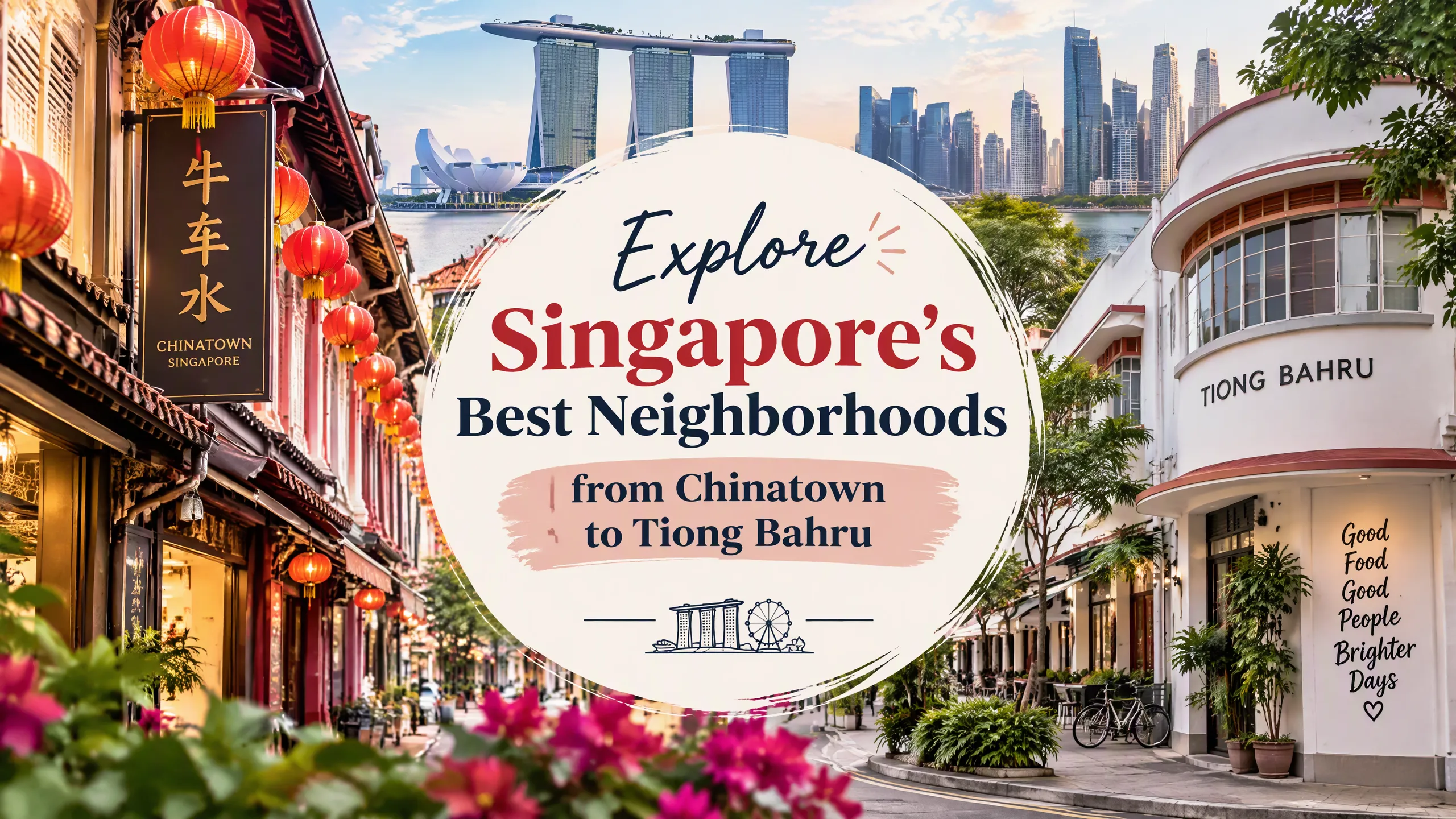
Singapore is about 50 kilometers across at its widest, yet it can hold a 19th-century Hindu temple, a Michelin-recognized hawker stall, and a staircase that exists mainly to be photographed, all within a few MRT stops. The hard part is not finding something to do. It is deciding which of your 14 snack plans to cancel.
This guide ranks neighborhoods by what they do best, not by a single winner. The picks weigh character, food, history, walkability, and MRT access. Facts are tied to official or institutional sources, and the Singapore Tourism Board’s Visit Singapore site is the best starting point for current events and planning. Hours, prices, and opening status change, so treat every venue detail here as something to confirm before you leave your hotel.
Key Takeaway
-
Chinatown: heritage temples, a museum, and some of the densest hawker food in the city.
-
Tiong Bahru: pre-war Art Deco-style housing, independent cafes, and a neighborhood market.
-
Kampong Glam: Malay and Arab heritage, the Sultan Mosque, and boutique-lined Haji Lane.
-
Little India: temples, a wet-market-style food centre, and shopping that runs late.
-
Katong and Joo Chiat: Peranakan shophouses, laksa, and kueh, away from the central tourist loop.
-
Tanjong Pagar, Holland Village, Dempsey Hill: nightlife, relaxed brunches, and greenery respectively.
-
The MRT makes pairing two neighborhoods in one day realistic. Three is possible, but your feet will file a complaint.
-
Check opening hours and event details on official pages before you go.
Neighborhood Cheat Sheet
|
Neighborhood |
Best for |
Signature sights or eats |
Nearest MRT (verify) |
Suggested time |
|---|---|---|---|---|
|
Chinatown |
Heritage and hawker food |
Buddha Tooth Relic Temple, Sri Mariamman Temple, Chinatown Complex Food Centre |
Chinatown (North East and Downtown lines) |
Half day |
|
Tiong Bahru |
Cafes, design, architecture |
Pre-war estate blocks, Tiong Bahru Market, murals |
Tiong Bahru (East-West Line) |
2 to 3 hours |
|
Kampong Glam |
Culture, shopping, street art |
Sultan Mosque, Haji Lane, Arab Street |
Bugis (East-West and Downtown lines) |
2 to 3 hours |
|
Little India |
Color, food, late shopping |
Sri Veeramakaliamman Temple, Tekka Centre, Mustafa Centre, Indian Heritage Centre |
Little India (North East and Downtown lines) |
Half day |
|
Katong and Joo Chiat |
Peranakan culture and food |
Koon Seng Road shophouses, laksa, kueh |
Thomson-East Coast Line stations near Katong |
2 to 3 hours |
|
Tanjong Pagar |
Dining and nightlife |
Restored shophouses, bars, restaurants |
Tanjong Pagar (East-West Line) |
Evening |
|
Holland Village |
Casual cafes and drinks |
Cafes and restaurants around the village |
Holland Village (Circle Line) |
2 hours |
|
Dempsey Hill |
Greenery and dining |
Former barracks turned restaurants |
Botanic Gardens (Circle and Downtown lines), then a short onward trip |
2 hours |
Station names and lines change as the network expands, so confirm them on the current map from the Land Transport Authority, which also publishes fares and payment options.
Chinatown: Heritage, Hawkers, and Temples Without the Quiet
Chinatown packs several centuries of migrant history into a few walkable streets. The Buddha Tooth Relic Temple on South Bridge Road is a multi-story Buddhist temple and museum. A few minutes away, Sri Mariamman Temple is widely described as Singapore’s oldest Hindu temple, founded in 1827. It is a useful reminder that “Chinatown” has never been only Chinese. The Chinatown Heritage Centre on Pagoda Street covers the lives of early residents, and Roots.gov.sg, run by the National Heritage Board, is the place for deeper background on sites and history.
Then comes the food, and the argument. Singapore’s hawker culture was inscribed on UNESCO’s Representative List of the Intangible Cultural Heritage of Humanity in 2020, which means your friend’s passionate defense of one particular chicken rice stall has international backing. The Singapore Food Agency oversees food safety and licensing for hawker centres, and the Michelin Guide Singapore lists recognized hawker stalls if you want a shortlist. Chinatown Complex Food Centre and Maxwell Food Centre are the usual starting points. Expect every local you ask to name a different “best” stall and to be mildly offended by your alternative.
Practical advice:
-
Go early. Lunch queues and midday heat arrive together, and neither is improved by the other.
-
Check payment options. Many stalls accept digital payments, but some are cash only. Carry small notes.
-
Dress for temples. Cover shoulders and knees, and follow posted rules about shoes and photography.
Tiong Bahru: Cafes, Bookshops, and Buildings With Good Posture
Tiong Bahru feels like a different city because it was built as one. The Singapore Improvement Trust developed the estate in the 1930s and later, and the low-rise blocks use a Streamline Moderne style with curved corners, balconies, and rounded stairwells. Some blocks were also built with civil air raid shelters, a detail that makes the neighborhood part of Singapore’s wartime story as well as its design story. The Urban Redevelopment Authority handles conservation planning, and Roots.gov.sg has heritage details if you want to read before you walk.
What visitors actually do is simple: wander the residential lanes, eat at Tiong Bahru Market and its food centre, browse independent bookshops and bakeries, and look for the murals that depict everyday scenes from old Singapore. Tiong Bahru is a residential estate, so keep voices down and do not treat balconies as props.
The social pressure here is real. You will face a wall of brunch options, choose one with the confidence of a person defusing a bomb, and then take 40 photos of a staircase. Nobody is judging, except possibly the staircase’s residents. If you are short on time, Tiong Bahru works as a two-hour stop: market, one cafe, one lap of the blocks.
Kampong Glam and Little India: Two Neighborhoods, Many Senses Engaged
Kampong Glam is the center of Singapore’s Malay and Arab heritage. The Sultan Mosque anchors the area, and its golden dome is visible from several streets. Visitors can usually enter outside prayer times, but access rules and dress requirements are set by the mosque, so check with it directly before you go. Nearby, Arab Street sells textiles and gifts, and Haji Lane squeezes boutiques, cafes, and street art into a very narrow lane. Bugis MRT is the usual access point.
Little India runs along Serangoon Road, with Little India MRT as the closest station. Sri Veeramakaliamman Temple is one of its best-known religious sites, Tekka Centre combines a wet market, hawker stalls, and clothing vendors, and the Indian Heritage Centre on Campbell Lane tells the story of Singapore’s Indian communities. Mustafa Centre is known for its enormous range and long opening hours, but confirm current hours before planning a midnight shopping run.
Both areas are sensory overload in the best sense: spices, jasmine garlands, silk, incense, and shopfronts competing for your wallet. A workable rule is to decide what you are shopping for before you enter. “A scarf” is a plan. “Whatever speaks to me” ends with five scarves and no recollection of agreeing to them.
The two areas sit close enough that an afternoon in one and an evening in the other is realistic. Check the LTA journey planner for the current route between Bugis and Little India.
Katong and Joo Chiat: Peranakan Colors and a Laksa Reality Check
Katong and Joo Chiat sit in the east, and they reward people who have already done the central loop. Koon Seng Road is famous for its pastel Peranakan shophouses with ornate tile work and carved details. Peranakan culture blends Chinese and Malay influences, and its food includes laksa, a spiced coconut noodle soup, and kueh, small sweet or savory snacks.
For context, the Peranakan Museum on Armenian Street reopened after a major revamp and is the main institutional stop for Peranakan history. The Intan, a private home museum of Peranakan objects, has historically operated by appointment, so contact them first rather than turning up and hoping.
Locals hold firm and friendly opinions about which laksa stall is best. Join in, but do not wear white. Laksa gravity is real, and your photo-ready outfit will not survive the first slurp. Choose stalls from current listings or trusted local recommendations, since shops here open, close, and relocate more often than guidebooks update.
More Neighborhoods Worth a Detour
-
Tanjong Pagar: restored shophouses, bars, and restaurants, best for evenings. It pairs naturally with Chinatown, which is a short walk away.
-
Holland Village: a relaxed cluster of cafes and casual restaurants on the Circle Line, suited to travelers who want brunch without a plan.
-
Dempsey Hill: former barracks turned into restaurants and shops among trees. Pair it with the Singapore Botanic Gardens, a UNESCO World Heritage Site. NParks lists the Gardens and other green spaces with current visitor information.
-
Marina Bay: the skyline district, home to Gardens by the Bay, where ticketing and attraction details are published on the official site. Evenings are cooler for an outdoor stroll.
How to Combine Neighborhoods Without Melting
|
Plan |
Morning |
Afternoon |
Evening |
|---|---|---|---|
|
Heritage and Hawkers Day |
Chinatown temples and heritage centre |
Early hawker lunch, then an air-conditioned break |
Tanjong Pagar dinner or drinks |
|
Culture and Color Day |
Kampong Glam: Sultan Mosque exterior, Arab Street |
Little India: temple, Tekka Centre, Indian Heritage Centre |
Haji Lane or Serangoon Road dinner |
|
Slow Brunch Day |
Tiong Bahru market and cafe |
Walk the estate and murals, then rest |
Holland Village or Dempsey Hill dinner |
|
East Side Day |
Katong shophouses and kueh |
Peranakan Museum or a laksa stop |
Return via Thomson-East Coast Line |
Humidity is the unofficial travel companion on all of these. Carry water, schedule at least one indoor stop (a museum, a mall, a food court with air conditioning), and treat midday as a rest period. Wear shoes you can walk in and clothes you can sweat in.
For transit, LTA publishes MRT maps, fares, and notices about service disruptions. Contactless bank cards are generally accepted at gantries, and LTA’s pages describe the current options for visitors. Check for planned closures before heading out, since a missing station can reshape a day.
Sources and Fact-Check Notes
The links below are the official starting points for the claims in this article. Details such as hours, prices, and opening status change, so open each page before you travel.
|
Claim or topic |
Source |
Link |
What to double-check |
|---|---|---|---|
|
Trip planning, events |
Visit Singapore (STB) |
Event dates, attraction status |
|
|
MRT lines, fares, disruptions |
Land Transport Authority |
Station names, payment options, closures |
|
|
Heritage sites and history |
Roots.gov.sg (NHB) |
Site descriptions, opening hours |
|
|
Tiong Bahru conservation |
Urban Redevelopment Authority |
Conservation area details |
|
|
Hawker centre regulation |
Singapore Food Agency |
Food safety grades, centre closures |
|
|
Recognized hawker stalls |
Michelin Guide Singapore |
Current listings and stall status |
|
|
Parks and Botanic Gardens |
NParks |
Garden hours, event closures |
|
|
Marina Bay attractions |
Gardens by the Bay |
Ticket prices, conservatory hours |
|
|
Peranakan history |
Peranakan Museum |
Opening hours, ticketing |
|
|
Buddha Tooth Relic Temple |
Official temple site |
Visiting hours, dress code |
Final Thoughts
The best neighborhood depends on what you do when nobody is making you do anything. Heritage fans should start in Chinatown and Kampong Glam. Food-motivated travelers should add Little India and Katong. Design and cafe people will be happiest in Tiong Bahru. Pick two or three areas, not eight, because Singapore is small enough to tempt you into overbooking and humid enough to punish it. Leave an hour of slack in your schedule and some room in your stomach, because someone will offer you one more snack.
FAQ
What is the best neighborhood in Singapore for first-time visitors? Chinatown is the easiest first pick. It combines temples, a heritage centre, hawker food, and MRT access in one compact area.
Is Tiong Bahru worth visiting if I am short on time? Yes, for two hours. Visit the market, have one coffee or pastry, and walk the pre-war blocks. If you only care about major landmarks, you can skip it.
How many neighborhoods can I see in one day? Two is comfortable, and three is possible if one is just an evening meal. Heat and queues slow everything down.
What is the easiest way to get around between neighborhoods? The MRT. Check the current network map and fare information on the LTA website, and use taxis or ride-hailing for short hops when it is very hot or raining.
When is the best time of day to explore in the heat? Early morning and evening. Use midday for indoor stops, such as museums, malls, or a long lunch.
Are these neighborhoods suitable for families and solo travelers? Generally yes. They are walkable and well served by transit, and food centres are easy for solo diners. Families should plan rest breaks and confirm any temple or mosque rules in advance.

