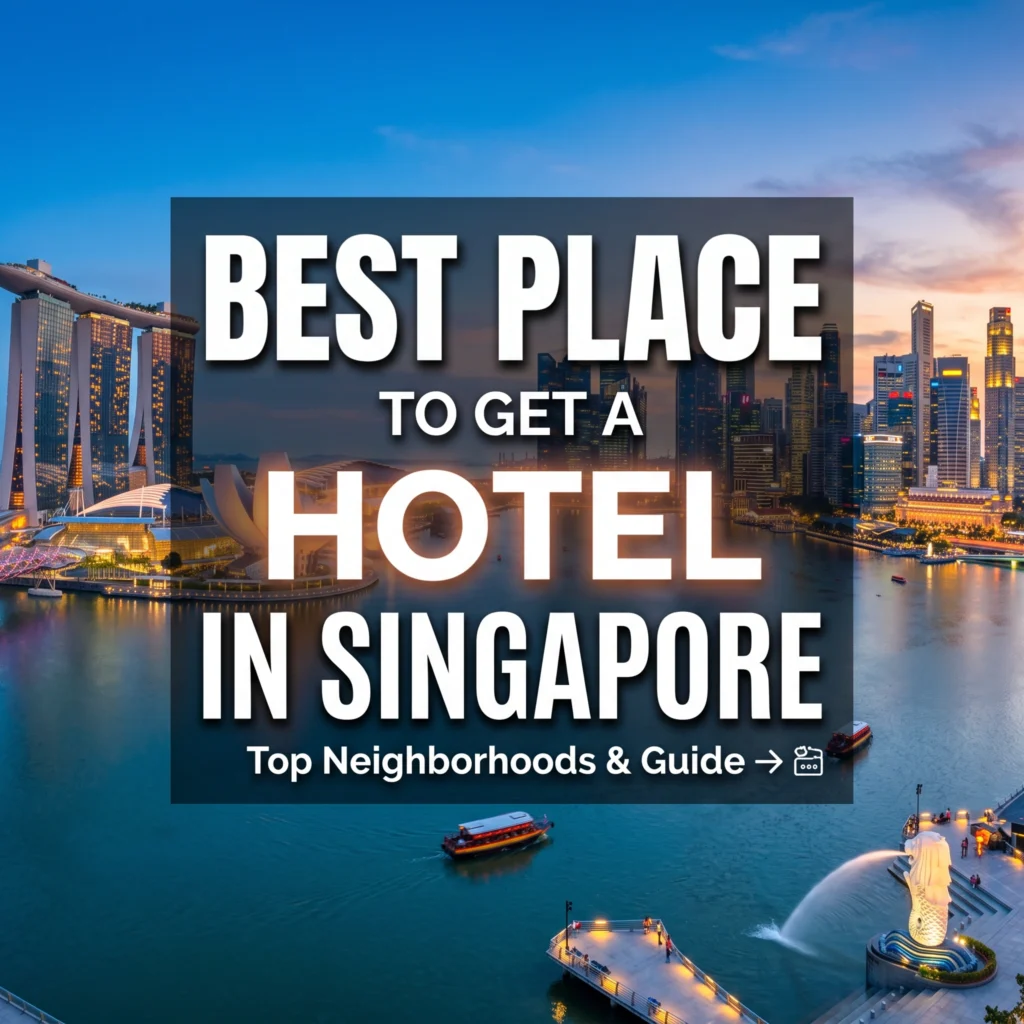

Singapore has a reputation problem. Ask most travelers what a week in the city state costs and they picture $400 rooms at the Marina Bay Sands, infinity pools, and cocktail prices that could cover a month of rent back home. That reputation is mostly true if you stick to the postcard hotels. But a different Singapore exists just a few MRT stops away from those rooftop bars, one where a clean, air conditioned room with a private bathroom runs $60 to $130 SGD a night, and where the savings you bank on lodging can fund your entire food budget for the trip. This chapter is a guide to that second Singapore.
The Budget Baseline: What “Value” Actually Means Here
Before comparing specific properties, it helps to know what a fair price actually buys in this market. Singapore’s land is scarce and its labor costs are high, so budget hotels here do not look like budget hotels in Bangkok or Ho Chi Minh City. You will not find $15 dorm beds with fans and shared squat toilets. Instead, the local budget tier splits into three rough bands.
At the low end, roughly $60 to $80 SGD a night, you get capsule style pods or compact windowless rooms, usually 80 to 110 square feet, with a private or semi private bathroom, split unit air conditioning, and free WiFi that is fast enough for video calls. The middle band, $80 to $105 SGD, adds a proper window or a slightly larger footprint, sometimes a mini fridge, and better soundproofing. The upper budget band, $105 to $130 SGD, starts to resemble a boutique hotel: real headboards, rainfall showers, occasional breakfast inclusion, and staff who remember your name by day two.
Across all three bands, a few things are non negotiable in this market and worth treating as your baseline checklist:
- Private en suite bathroom, since shared bathrooms are rare outside true hostels
- Individually controlled air conditioning, since Singapore’s heat and humidity make this a comfort issue, not a luxury
- Complimentary WiFi with enough bandwidth for streaming or video calls
- A location within a 10 minute walk of an MRT station, which matters more here than almost any other single amenity
What you should not expect at this price point: a swimming pool, a full service gym, daily housekeeping with turndown service, or a large room. Singapore’s budget hotels sell efficiency, not space. A 90 square foot room with excellent air conditioning and a five minute walk to the train will almost always deliver a better trip than a 200 square foot room stuck in a residential pocket with no direct transit line. That single idea, prioritizing access over square footage, is the thread running through every recommendation in this chapter.
The Five Hotels That Actually Deliver
After weighing nightly rates against location, room quality, and guest feedback across booking platforms, five properties consistently rise to the top of Singapore’s value tier: Hotel 81 Premier Star in Geylang, ibis budget Singapore Bugis, Champion Hotel in Joo Chiat, Spacepod@hive near Boon Keng and Kallang, and ST Signature Chinatown. Each targets a slightly different type of traveler, and none of them try to be everything at once. That focus is exactly why they work.
Here is how they stack up side by side on the metrics that matter most: room size, soundproofing, cleanliness, luggage storage, and distance to the nearest train station.
| Hotel | Average Room Size | Soundproofing | Cleanliness Score | Walk to MRT |
|---|---|---|---|---|
| Hotel 81 Premier Star, Geylang | 140 sq ft | Good | 8.6 / 10 | 4 minutes, Aljunied |
| ibis budget Singapore Bugis | 129 sq ft | Very Good | 8.9 / 10 | 7 minutes, Bugis |
| Champion Hotel, Joo Chiat | 150 sq ft | Fair | 8.4 / 10 | 12 minutes, Paya Lebar |
| Spacepod@hive, Boon Keng | 90 sq ft, pod style | Good | 8.7 / 10 | 5 minutes, Boon Keng |
| ST Signature Chinatown | 100 sq ft, some windowless | Very Good | 9.0 / 10 | 3 minutes, Chinatown |
A few patterns jump out immediately. ST Signature Chinatown posts the highest cleanliness score and the shortest walk to a train station, despite having some of the smallest rooms on the list. Champion Hotel offers the most square footage by a wide margin, but its soundproofing lags behind the others and it sits the farthest from a station. Spacepod@hive proves that pod style rooms, often dismissed as a novelty, can deliver strong ratings when the design is done well and the location is convenient. And ibis budget Bugis, backed by the global Accor brand’s consistency standards, delivers the most balanced numbers across every category without being the best in any single one.
Luggage storage deserves its own mention, since it is an amenity budget travelers often forget to check until they are standing in a lobby with two suitcases and an early checkout. All five properties offer complimentary luggage storage, but the systems differ. Hotel 81 Premier Star and Champion Hotel use a traditional staffed storage room, fine for short waits but slower during peak checkout hours. ST Signature Chinatown and Spacepod@hive use lockers, which means faster self service retrieval but a hard size limit, so oversized suitcases may not fit. ibis budget Bugis sits in between, with a manned storage area that is typically fast because of higher staffing levels tied to the Accor brand standard.
What You Give Up, and What You Get Back
Every one of these hotels is cheaper than a comparable mid range property in the same neighborhood, and the gap is not small. Depending on the season, you are looking at savings of $50 to $100 SGD per night compared to a standard three star hotel in the same district. That is real money over a five night stay, often enough to cover an entire extra day of food and activities. But that savings comes from somewhere, and understanding exactly where lets you decide if the tradeoff works for your trip.
The most common sacrifice is the window. Several of the cheapest rooms at ST Signature Chinatown and Spacepod@hive are windowless by design, a common configuration in dense urban buildings where interior rooms cost less to build and maintain. This sounds worse than it is. If your daily routine involves waking up, showering, heading out to explore the city, and returning only to sleep, a windowless room is functionally identical to one with a view of an air shaft. You save $15 to $25 SGD a night for a feature you were not going to use anyway. The travelers who regret this tradeoff are the ones planning to spend afternoons lounging in the room, working remotely, or nursing jet lag with daylight streaming in. If that is your itinerary, pay for the window.
The second tradeoff is self service infrastructure. ST Signature Chinatown and Spacepod@hive both lean on kiosk check in and app based room access rather than a 24 hour staffed front desk. This cuts labor costs, which gets passed on to you as a lower rate, but it means less human troubleshooting if something goes wrong at 2 a.m. For most travelers this is a non issue; Singapore’s infrastructure is reliable enough that kiosk check in rarely causes real problems. But if you are traveling with elderly parents, young children, or you simply want a person to talk to when you land jet lagged and disoriented, factor that into your decision.
Third, none of these five hotels have a swimming pool, and only one, Champion Hotel, has anything resembling a fitness area, and even that is minimal. This is standard for the budget tier across the entire city, not a shortcoming specific to these properties. If a pool is a trip requirement, you are shopping in a different price bracket entirely, likely $180 SGD and up.
Here is a simple way to decide whether a lower rate is actually the better deal once you factor in your daily transit costs. Call it the per kilometer transit savings formula. Take the nightly rate difference between two hotels you are considering. Then estimate how many extra minutes and dollars you will spend each day getting from the cheaper, farther out hotel to your planned destinations, using Singapore’s MRT fare structure, which runs roughly $1 to $2.50 SGD per ride depending on distance. If a hotel saves you $20 SGD a night but adds two extra train transfers and 20 minutes each way to reach the city center, you are spending that savings back in fares and losing time you could have spent seeing the city. A rough rule that works well in practice: if the transit cost difference eats more than half of your nightly savings, the cheaper hotel is not actually cheaper once you count total trip cost.
Run the numbers before you book, not after. Pull up a satellite map of your shortlisted hotel and trace the walking route to the nearest MRT entrance. Anything under 500 meters, roughly a 6 to 7 minute walk, is excellent. Between 500 and 800 meters is still workable, especially if the route is shaded or covered, which many are in Singapore thanks to its extensive network of covered walkways. Beyond 800 meters, especially in the heat and humidity, that budget hotel starts costing you in taxi fares and sweat equity.
The Hidden Fee Trap: Reading the Real Price
Singapore hotel pricing has a quirk that catches first time visitors off guard: the quoted rate you see on a booking site is often not the rate you pay. Two charges get added at checkout or buried in fine print, and together they can inflate your bill by nearly 20 percent.
The first is a 10 percent service charge, standard across the hospitality industry here. The second is Singapore’s Goods and Services Tax, currently 9 percent, applied to most goods and services including hotel stays. Some properties list rates as “nett,” meaning taxes and service charges are already folded in. Others list a base rate with “+++” next to it, hotel industry shorthand meaning service charge and GST will be added on top. If you do not know to look for that little symbol, you can end up budgeting for a $90 room and getting hit with a $107 bill.
Here is a four step check to run before you commit to any booking, whether you are using a third party site or booking direct:
- Find the fine print near the price. Look specifically for the word “nett” or the “+++” symbol next to the rate.
- If you see “+++,” multiply the base rate by 1.199 to get your real nightly cost. This accounts for 10 percent service charge, then 9 percent GST applied afterward.
- Compare that adjusted number, not the headline number, across every hotel on your shortlist. A $75 rate marked “+++” often ends up more expensive than an $85 rate marked “nett.”
- Screenshot the confirmation page once you book, since discrepancies between quoted and charged amounts are easier to dispute with documentation in hand.
Third party booking sites based outside Singapore sometimes strip out this distinction entirely, showing an all in price that looks suspiciously low compared to booking direct. When that happens, it is worth double checking the hotel’s own website before committing, since currency conversion quirks and hidden booking fees can offset any apparent savings.
Location Scorecard: Where You Sleep Shapes Your Trip
Room quality matters, but in a city built around one of the world’s most efficient subway systems, location often matters more. Singapore’s MRT network reaches nearly every corner of the island, and Changi Airport and Marina Bay are both connected by direct or one transfer lines from most central districts. That means the neighborhood surrounding your hotel deserves as much scrutiny as the room itself.
Rating each of the five neighborhoods on walkability, perceived safety, late night food access, and convenience store density paints a clear picture of what daily life looks like at each address.
Chinatown, ST Signature Chinatown
Chinatown scores highest across the board. It is flat, well lit, and busy well past midnight, which in Singapore translates to genuinely safe streets even at 1 a.m. Maxwell Food Centre sits a short walk away, home to Tian Tian Hainanese Chicken Rice and dozens of other hawker stalls serving until late evening. Convenience stores are everywhere, and the Chinatown MRT station connects directly to lines reaching both Changi Airport, via one transfer at Tanah Merah, and Marina Bay, a direct four stop ride.
Bugis, ibis budget Singapore Bugis
Bugis runs a close second. The area is a genuine crossroads of old shophouses, street markets, and modern malls, which means foot traffic stays high into the night and the streets feel active rather than empty. Bugis Street’s hawker offerings run late, and the neighborhood has a dense cluster of 24 hour convenience stores and pharmacies. Bugis station sits on two MRT lines, giving direct access to both the airport corridor and the Marina Bay area without multiple transfers.
Boon Keng and Kallang, Spacepod@hive
Boon Keng and Kallang is quieter and more residential, which cuts both ways. It is extremely safe, arguably safer than the busier tourist zones simply because there is less foot traffic and fewer late night crowds, but that also means fewer hawker options within immediate walking distance after 10 p.m. Old Airport Road Food Centre, one of Singapore’s most respected hawker sites, is a short bus or short MRT plus walk trip away rather than a direct stroll. Convenience stores exist but are more spread out than in Chinatown or Bugis.
Geylang, Hotel 81 Premier Star
Geylang is the neighborhood most likely to surprise first time visitors, and it deserves an honest explanation. Geylang has a reputation, partly earned, for its red light district activity concentrated in specific side streets, or lorongs. The main thoroughfares, however, are heavily trafficked, well policed, and home to some of the best late night food in Singapore, including durian stalls that operate past midnight and a rotating cast of hawker stands serving frog leg porridge and barbecue stingray until the early hours. Travelers who stick to the main road and treat it like any dense urban neighborhood report feeling safe. Those uncomfortable with a red light district existing anywhere nearby should look elsewhere. Practically speaking, Aljunied MRT station is a four minute walk, and the line connects efficiently to both the airport and downtown.
Joo Chiat, Champion Hotel
Joo Chiat is the most charming neighborhood on this list and the least transit convenient. It is a Peranakan heritage district full of colorful shophouses, excellent Katong laksa, and a genuinely relaxed, low crime atmosphere. The tradeoff is the 12 minute walk to Paya Lebar MRT, longer than ideal if you are planning multiple trips into the city center each day. Convenience stores are present but thinner on the ground than in the denser central districts. This is the neighborhood to pick if you value atmosphere and food culture over transit speed, not the one to pick if you are trying to squeeze maximum sightseeing into a short trip.
Two Travelers, Two Strategies
Eugene Walsh, a solo traveler on a two week Southeast Asia loop, booked five nights at ST Signature Chinatown specifically because of its co living style communal kitchen. Rather than buying breakfast and coffee out every morning, a habit that easily runs $10 to $15 SGD a day in central Singapore, he shopped once at a nearby supermarket and used the shared kitchen each morning. By his own accounting, that single habit saved him roughly $35 SGD a day between breakfast and coffee runs, money he redirected into a Gardens by the Bay ticket and a Singapore Zoo night safari he had not originally budgeted for.
The hotel’s three minute walk to Chinatown MRT meant he never once considered a taxi during his stay, even with an early flight out of Changi.
Linda Barnett and Wayne Bradley, a couple celebrating an anniversary on a tighter budget than they would have liked, took a different approach. They booked a compact double at ibis budget Bugis, accepting a smaller room than they would normally choose in exchange for the brand consistency and central location. The math worked in their favor: a $95 a night room in Bugis compared to $170 for a similar sized room at a mid range hotel near Marina Bay left them with roughly $75 SGD a night in freed up budget.
Over their five night stay, that surplus funded dinners at two Michelin recognized hawker stalls, Hill Street Tai Hwa Pork Noodle and Liao Fan Hawker Chan, both destinations they had assumed would be out of reach on their trip budget.
Their takeaway, echoed by plenty of couples who try this same math: a slightly smaller room is an easy trade when the savings buy you the exact food experience you came to Singapore for in the first place.
The Five Minute Room Check
Booking confirmations and online photos only tell you so much. The single best habit a budget traveler can build in Singapore is a quick, methodical check of the room in the first five minutes after arrival, while you are still standing in the doorway with your bags. This costs nothing and it is the difference between catching a problem while the front desk can still fix it and discovering it at midnight when nothing can be done.
- Air conditioning first. Turn it on immediately and hold your hand near the vent. In Singapore’s climate, a weak or slow to cool unit is not a minor inconvenience, it is a sleep quality emergency. If it is not blowing cold within two or three minutes, call the front desk before you unpack.
- WiFi speed test. Run a quick speed test on your phone using any free app. Anything under 10 Mbps download is going to struggle with video calls or streaming. Budget hotels vary wildly here even within the same building, since older wiring in converted shophouse properties sometimes creates dead zones on upper floors.
- Soundproofing. Stand near the door and the shared wall and listen for hallway noise or neighboring room chatter. If you can hear a normal conversation clearly through the wall, ask about switching to a room farther from the elevator or stairwell, which is almost always the noisiest spot on any floor.
- Bathroom function. Run the shower for thirty seconds and check water pressure and drainage. Slow drains are a common and easily missed issue in older converted buildings.
- Window and blackout check. If your room has a window, check whether the curtains or blinds actually block light, since Singapore’s early sunrise, often before 7 a.m. year round, can wreck a sleep schedule if the room lets in daylight.
This routine takes less time than unpacking a single suitcase, and hotels in this price tier expect it. Front desk staff at all five properties on this list are used to quick room swap requests in the first ten minutes of a stay, precisely because compact, budget focused buildings sometimes have inconsistent units on different floors.
The Smart Pick: Matching the Hotel to the Traveler
No single hotel on this list is the best one outright. The right choice depends entirely on what kind of trip you are taking, and being honest about your own travel habits will save you more money than any single hack in this book.
- Solo backpackers and digital nomads on tight budgets should look first at ST Signature Chinatown or Spacepod@hive. Both offer the lowest entry price points, communal or co living touches that cut food costs, and walk times to the MRT under six minutes. The windowless rooms are a non issue if your days are spent out exploring rather than lounging indoors.
- Couples wanting central access without paying central prices should default to ibis budget Bugis. The brand consistency reduces the risk of an unpleasant surprise, and the neighborhood’s dual MRT lines make day tripping in any direction simple. It is the safest all around pick for travelers who have never stayed in Singapore’s budget tier before and want a gentle introduction.
- Food focused travelers and heritage enthusiasts with a bit more flexibility on transit time should consider Champion Hotel in Joo Chiat. The neighborhood itself is a destination, and the larger rooms suit travelers planning quieter, slower paced days rather than packed sightseeing itineraries.
- Short stay transit visitors, meaning anyone on a layover style visit of one or two nights before a connecting flight, should prioritize Hotel 81 Premier Star or ST Signature Chinatown, both offering fast MRT access to Changi Airport with minimal transfers. When your priority is minimizing travel time rather than maximizing neighborhood charm, station proximity should outweigh every other factor on this list.
- Adventurous travelers comfortable with a livelier, more urban edge and drawn to exceptional late night hawker food should give Hotel 81 Premier Star in Geylang a serious look, understanding the neighborhood’s reputation going in rather than being surprised by it after arrival.
Your Pre Booking Checklist
Before you hit confirm on any of these five properties, or any Singapore budget hotel for that matter, run through this short list:
- Confirm whether the quoted rate is “nett” or “+++,” and calculate your real total using the 1.199 multiplier if service charge and GST are not included.
- Trace the walking route from the hotel to the nearest MRT entrance on a satellite map, and treat anything over 800 meters as a real cost, not a minor inconvenience.
- Book four to six weeks ahead whenever possible. Singapore hosts major conventions and events throughout the year, and rates at these budget properties can spike 30 percent or more during events like the Singapore Airshow or major conferences at Marina Bay Sands’ convention center.
- Download a local transit app, such as SimplyGo or Citymapper, before you land, so you can plan routes and estimate daily fares from your hotel base rather than guessing once you are jet lagged and standing at an unfamiliar station.
- Run the five minute room check the moment you arrive, and do not hesitate to request a room change if the air conditioning, WiFi, or soundproofing falls short.
Singapore’s budget hotel tier is not about settling for less. It is about spending your money on the things that actually shape a trip: fast, direct access to the city’s transit spine, a room cold and quiet enough to sleep well in, and a location close enough to a great hawker stall that you can eat like a local every single night. Get those three things right, and the size of your room stops mattering within about a day.